St John the Baptist Catholic Primary School
Our School Saints
Together, through our words and actions, our work and play, we point towards Christ each and every day.
We strive to work together (home, parish, and school) to inspire, challenge, and educate every child, to accompany them in their journey to fulfil their unique, God-given talents within our society. We do this through a quality education with high expectations, firmly based on Gospel Values, and lived out in a caring and worshipping Catholic community. Our Christian duty is to develop every child spiritually, morally, socially, and culturally so they are prepared and equipped to take their place in the world of tomorrow.
Our House System
When children join our school family, they are arranged into one of four House Groups: St. Rose of Lima, St. Francis of Assisi, St. Martha and Blessed John Bodey. Each House is led by an elected House Captain chosen from the Year 6 pupils by the children within that House.
The House groups meet every fortnight, led by their House Captain,s to:
- Discuss upcoming school events
- Share ideas for school improvement
- Choose their own charity and organise fundraising activities
- Celebrate achievements within the House team
- Encourage each other, build the skills of cooperation, listening, and negotiation
The House Captains are also responsible for collecting the House Points earned by each class weekly and reporting these in our Mission Assemblies to the whole school, staff, and visiting friends and family. They play an integral role in sports day by leading their teams through a range of sporting challenges and providing encouragement as each House strives to be the champions!
Blessed John Bodey
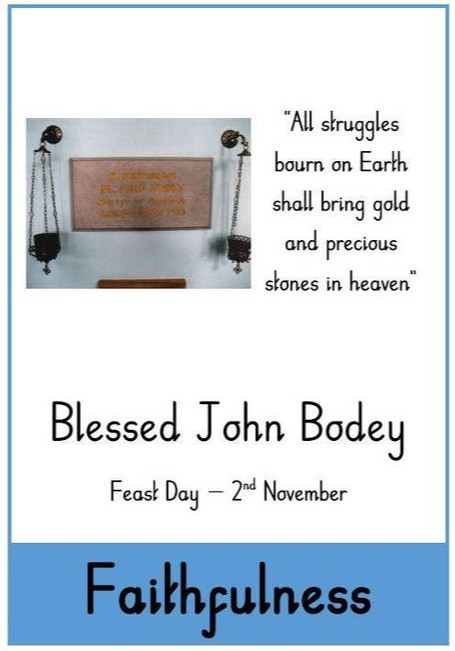 An English martyr and school teacher.
John Bodey was born at Wells, Somerset, and educated at Oxford. His father was a wealthy merchant and John studied at Winchester College and New College, Oxford. He became a fellow of Oxford and completed a master's degree in 1576.
After converting to the Catholic faith, John studied law at Douai in 1557 and returned to England to become a school teacher in Hampshire and to get married.
When he refused to accept King Henry VIII's claim of supremacy in spiritual matters, John was arrested. John was imprisoned at Winchester until 1583.
On the morning of November 2nd 1583, John was taken from the town jail in Bridge Street, strapped to a hurdle and drawn through the streets of Andover to the scaffold in Market Place, where he died from hanging.
He was beatified by Pope Pius XI in 1929.
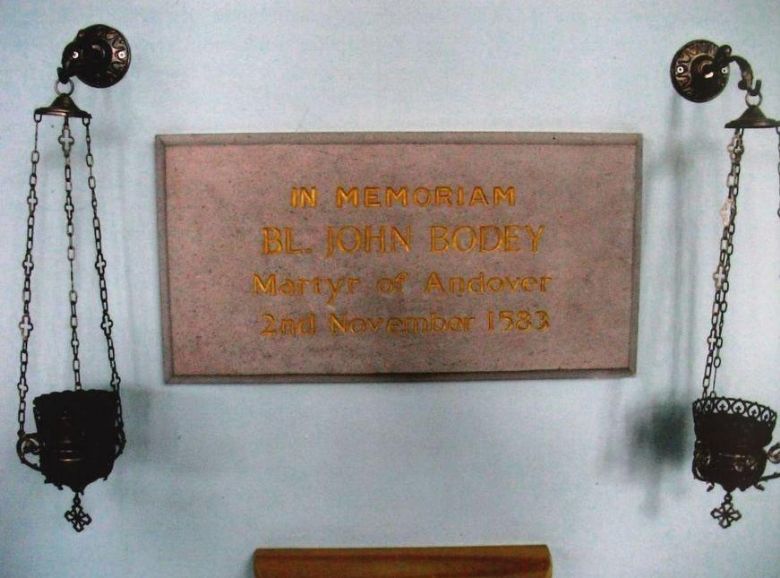
The plaque is located on the left side of the sanctuary near the sacristy of St John the Baptist Church, Andover.
St Rose of Lima
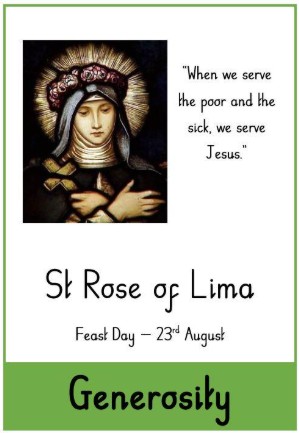 Gaspar de Flores and his wife, Maria de Olivia, were proud of their daughter. She was born on April 20, 1586, and was baptised Isabel de Flores. One day, a maid exclaimed that she looked just like a rose. Isabel’s mother declared that this child would be called “Rose” from then on. Isabel took Rose as her Confirmation name.
Rose liked to work in the garden. She also learnt to embroider on silk and to create designs, usually of flowers. Rose took Saint Catherine of Siena as a model. Even as a child, she wanted to live only for Jesus. She looked for difficult things to do to show her love for him. She also built a prayer hut for herself in the backyard. Then her parents experienced financial difficulties. Rose found an answer to this problem. To help her parents, she stayed home and sold her needlework and the flowers she raised, but she joined the Third Order of Saint Dominic as well. She began to live in her hut. In her parents’ home, she set up one room as a free medical clinic for children who were poor and people who were elderly. This became the beginning of social service in Peru.
In the last years of her life, Rose became very ill, and she died on August 24, 1617. By then, she was widely known and loved by both rich and poor people.
St Martha
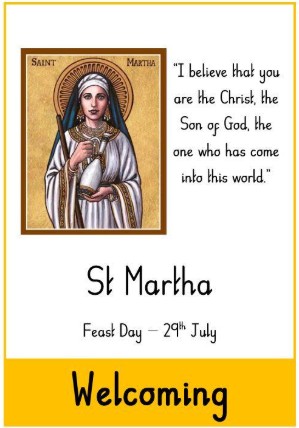 One of the most precious things in life is to have a home where you can go at any time and find people who accept, love and understand you. Jesus found such a home in Bethany, at the house of a woman named Martha. She welcomed him and served him, and they developed a special bond of friendship.
Martha lived with her sister Mary. Like many other pairs of sisters, these two women were different in personality. Martha was energetic and outspoken, while Mary was quiet and reflective. Jesus loved both of them and appreciated the gifts that each one had.
The Gospel of Luke records that once, when Jesus was visiting, Martha prepared the meal while Mary sat talking to their visitor. Martha complained that Jesus should tell Mary to help her. Jesus said that because Martha was worrying so much about the work, she did not have time to enjoy being with him and listening to his words.
Another time, recorded in John’s Gospel, the sisters sent a message to Jesus that their brother, Lazarus, was ill. They knew Jesus would come and cure him; they trusted in his loving care for them. When Jesus finally came, Lazarus had already been dead for four days. As soon as she heard that Jesus was nearby, Martha, a woman of action, went out to meet him, while Mary stayed in the house. In her grief, Martha told Jesus honestly what she had expected from him. Jesus asked her to believe that he was the resurrection and that he had the power to give eternal life to all who believed in him. Without really understanding this mystery, Martha trusted Jesus totally and said, “I believe that you are the Christ, the Son of God, the one who was to come into this world” (John 11:27). That day, Jesus raised her brother Lazarus from the dead, showing that he has power over life and death and power to give eternal life.
The home Jesus found in Bethany was not only in the house but in the faithful heart of a woman named Martha.
St Francis of Assisi
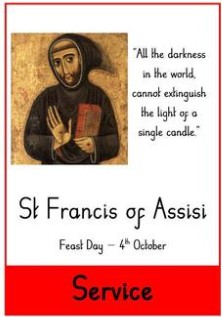 Francis was gentle and loved God’s creation, but he was not naive. Just the opposite. As a youth, he went to war eagerly, patiently endured imprisonment and illnesses, embraced poverty, and gave up everything to follow Christ. The real St. Francis of Assisi was a courageous spiritual warrior.
Francis’s vocation cost him dearly. Decision by decision, he stripped himself of attachments so as to be more like Jesus. Once en route to a war in southern Italy, Francis heard a divine voice invite him to stop serving the servant and dedicate himself to the master. He responded by committing himself to live for God alone. In his early twenties, Francis decided to become like the poor he met in Assisi’s back streets. Then one da,y when Francis was praying in the dilapidated church of St. Damian, he heard a voice from the crucifix say, “Go and repair my church.” At first, Francis literally worked to fix the building, but later understood that his real call was to renew people spiritually. From that day, Francis devoted himself to Christ crucified.
Then Francis began his itinerant ministry in central Italy, attracting young followers as he went. Once in 1209 at Mass, he heard the gospel about Jesus sending his disciples to preach, to heal, and to do spiritual warfare. He took it literally as a life pattern for him and his band of men (see Matthew 10:7–10). In 1210, Francis got formal approval for his community of Friars Minor from Pope Innocent III, and by 1221, he had hundreds of brothers and had established friaries all over Europe. In 1224, at his retreat on Mount Alvernia, Francis had a vision of a seraph, a great angel, nailed to a cross. As he watched, Francis himself received the stigmata. Replicas of the Saviour’s wounds appeared in his hands and side, acknowledging the saint’s intimacy with Christ. The movement Francis launched has reverberated through the centuries, touching millions of souls. He died in 1226.