
St John the Baptist Catholic Primary School
Bricks for '26
"You can't go back and change the beginning, but you can start where you are and change the ending"
C.S. Lewis

The Problem
When smartphones were first introduced to children, we were unaware of their potential impact. Now, a growing body of evidence links smartphone use to various harms, including anxiety, depression, and loneliness. Smartphones can expose children to pornography, cyberbullying, grooming, and violent or extreme content. Research indicates that smartphones can negatively affect academic performance, and many children exhibit signs of behavioural addiction to their devices.
One of the most sig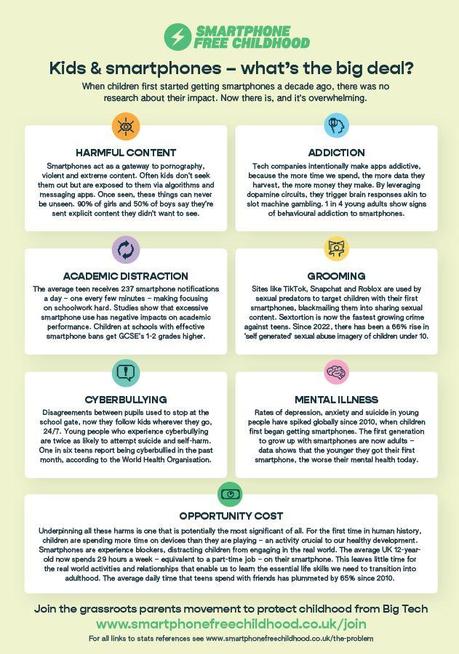 nificant issues is that smartphones act as experience blockers, distracting children from engaging with the real world. The average UK 12-year-old now spends 29 hours a week – equivalent to a part-time job – on their smartphone. This leaves little time for real-world activities and relationships that are crucial for developing essential life skills needed for the transition to adulthood. Research shows that the younger a child receives their first smartphone, the worse their mental health tends to be.
Despite this, the age at which children receive their first smartphone is decreasing. In the UK, a fifth of 3-4 year-olds and 24% of 5-7 year-olds own their own devices. Many parents feel pressured to give their child a smartphone to avoid isolating them from their peers. While better regulation of Big Tech is needed, enacting legislation takes years – time that we, as parents of children today, do not have. In the meantime, our most powerful defence lies in banding together and taking collective action.
We are proud to be a phone-free school, where children are not allowed to bring phones into school until they reach Years 5 and 6, and only then if they are walking home alone. This policy is an important step in preparing them for secondary school. Phones brought to school are handed in to an adult and returned at the end of the day. Additionally, phones are not permitted on school trips or residential visits.
What we’re asking of you: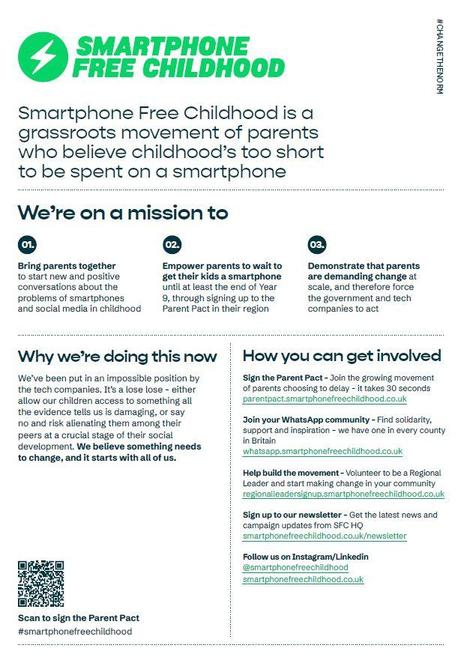
- Simple Phones only. From September 2026, smartphones will not be permitted in school. Those children in Year 5 and Year 6 who travel independently to and from school will be permitted to bring a 'brick' phone only. A list of simple phones can be found here: https://smartphonefreechildhood.co.uk/alternatives
- Sign the Pact. By signing this Pact, you join a fast-growing community of families across the UK who are choosing to wait to give their child a smartphone until at least the end of Year 9. It takes 30 seconds to sign the Parent Pact, and the more who do, the quicker we'll change the social norm. https://parentpact.smartphonefreechildhood.co.uk/
A Stolen Childhood (Main film)
Watch time:11:24 minutes 9 in 10 children are given a smartphone by the age of eleven. How is unlimited internet and/or social media access affecting our children's sense of well-being? Current research suggests that the messages they receive during these formative years can shape our children's beliefs about themselves and the world around them - sometimes adversely affecting their mental health.