
St John the Baptist Catholic Primary School
Curriculum
"Whatever you do, work at it with all your heart, as though you were working for the Lord"
Colossians 3:23
Our Curriculum
The school aims to recognise and develop the original gifts of our young people, preparing them for service in the common good, for the transformation of society, and academic excellence for all, for the sake of the dignity of the individual.
Our curriculum aims to provide for the spiritual, academic, physical and social development of every child, within a calm and structured atmosphere conducive to effective learning that reflects St John the Baptist's Catholic School's strong Catholic ethos.
Teaching and Learning at SJB
Structure and the belief that all children can achieve is central to all learning at St John the Baptist Catholic Primary School. In every subject, recalling prior knowledge and skills forms the foundation of our approach to the curriculum. This ensures that essential, related knowledge and skills are revisited and connected to children's current learning across all subjects. Key concepts and end points for each learning journey are highlighted, with over-learning reinforced through repetition, modelling, and scaffolding. Our subject-specific Schemes of Work ensure that learning is progressive and sequential for all children. Additionally, reading and vocabulary are emphasised in every subject, helping key concepts to become embedded in long-term memory.
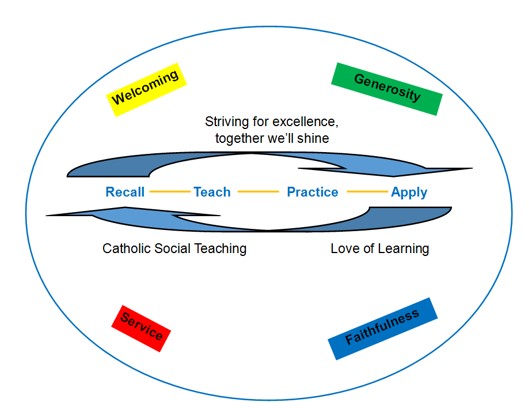
Our Lesson Structure: How We Help Children Learn and Grow
At our school, every lesson or learning journey follows a simple, effective structure designed to help children understand, practice, and apply what they learn. This approach ensures that learning is meaningful and lasting.
-
Recall – We start by revisiting what children already know. This helps them make connections and feel confident as they build on their knowledge.
-
Teach – Next, teachers introduce new ideas or skills in a clear and engaging way, so every child understands the key concepts.
-
Practice – Children then have time to practice what they’ve learnt. This step is important for building confidence and mastery.
-
Apply – Finally, students apply their learning to real-life situations or problem-solving tasks. This makes learning relevant and encourages deeper understanding.
Our Catholic Curriculum
At our school, learning is more than just gaining knowledge – it’s about forming the whole person. Our curriculum is built on the principles of Catholic Social Teaching, which means every subject is taught with values that reflect dignity, respect, and responsibility towards others.
What Makes Our Curriculum Different?
- Faith at the Heart – Learning Journeys are shaped by Catholic Social Teaching principles, helping children understand how their learning connects to living a life of compassion and service.
- Learning with Purpose – Subjects like science, art, history, and computing are linked to themes such as stewardship, solidarity, and the common good. This encourages children to see how their knowledge can make a positive difference in the world.
- Developing the Whole Child – We don’t just aim for academic success; we nurture character, faith, and a sense of responsibility to others.
Art and Design
Art and design stimulate creativity and imagination. It provides visual, tactile, and sensory experiences and a special way of understanding and responding to the world. It enables children to communicate what they see, feel and think through the use of colour, texture, form, pattern, and different materials and processes. Children become involved in shaping their environments through art and design activities. They learn to make informed judgments and aesthetic and practical decisions. They explore ideas and meanings through the work of artists and designers. Through learning about the roles and functions of art, they can explore the impact it has had on contemporary life and that of different times and cultures. The appreciation and enjoyment of the visual arts enriches all our lives.
We aim to:
- Enable children to record from first-hand experience and from imagination, and to select their own ideas to use in their work
- Develop children’s creativity and imagination through a range of complex activities
- Improve the children’s ability to control materials, tools, and techniques
- Increase children’s critical awareness of the roles and purposes of art and design in different times and cultures
- Develop increasing confidence in the use of visual and tactile elements and materials
- Foster an enjoyment and appreciation of the visual arts and build knowledge of artists, craftspeople, and designers.
The SJB Art Curriculum has the National Curriculum as its basis and has ambition for all firmly rooted in it. Our Learning Journeys are reviewed regularly and are sequential, with clear prior knowledge/skills identified. Key vocabulary is emphasised to enhance children’s learning and understanding, and there are clear end goals. Art is linked to other subjects when appropriate to further enhance children’s learning. We have considered skills progression in each area of art, where art skills are broken down into their parts and built upon throughout the topics.
In Early Years, by following the EYFS curriculum and focusing on Expressive Art and Design, children are provided with regular opportunities to engage with the arts, enabling them to explore and play with a wide range of media and materials. The quality and variety of what children see, hear and participate in is crucial for developing their understanding, self-expression, vocabulary and ability to communicate through the arts. The frequency, repetition and depth of their experiences are fundamental to their progress.
Computing
Computing is essential for all children, as it is at the heart of every modern household and therefore will be key to their journey through life. As Digital Natives, our children need to be able to use and express themselves as well as develop their ideas through technology, at a level suitable for the future workplace and as positive, active participants in a digital world. We strive for pupils who are equipped to create programs and systems which accomplish specific goals and contain a range of content, whilst instilling fundamental behaviours which will empower children to keep themselves safe online.
Design Technology
Design and technology is an inspiring, rigorous, and practical subject. Using creativity and imagination, pupils design and make products that solve real and relevant problems within a variety of contexts, considering their own and others’ needs, wants, and values. They acquire a broad range of subject knowledge and draw on disciplines such as mathematics, science, engineering, computing, and art. Pupils learn how to take risks, becoming resourceful, innovative, enterprising, and capable citizens. Through the evaluation of past and present design and technology, they develop a critical understanding of its impact on daily life and the wider world. High-quality design and technology education make an essential contribution to the creativity, culture, wealth, and well-being of the nation.
We aim to:-
- Develop imaginative thinking in children and enable them to talk about what they like and dislike when designing and making
- Enable children to think and talk about how things work, to draw and model their ideas
- Encourage children to select appropriate tools and techniques to make quality products, whilst following safe procedures.
- Use and explore a range of materials, resources, and equipment
- Explore attitudes towards the made world and how we live and work within it;
- Develop an understanding of technological processes, products, their manufacture, and their contribution to our society
- Use the internet to explore ideas and research products/design/designers.
- Foster enjoyment, satisfaction, and purpose in designing and making things
- Engage children with the principles of nutrition and food preparation
In the Early Years Foundation Stage, design and technology form part of the learning children acquire under the ‘Knowledge and Understanding of the World' branch of the Foundation Stage curriculum. The children learn through first-hand experiences and are encouraged to explore, observe, solve problems, think critically, make decisions and talk about why they have made their decisions.
The SJB Design Technology Curriculum covers the aims and skills outlined in the National Curriculum through broad, challenging and inspiring learning journeys. The Learning Journeys aim to deliver the content within a meaningful context, and wherever possible, cross-curricular links are exploited.
English
Reading
At SJB, we believe that creating a culture of reading is a vital tool in ensuring our children are given the best life chances. Cultivating passion in our readers will ensure that their love of reading will extend far beyond the classroom and allow them to build on their skills independently through a real curiosity and thirst for knowledge.
Research has found that reading for pleasure can result in increased empathy, improved relationships with others, reductions in the symptoms of depression and dementia, and improved well-being. In addition to the health benefits, reading for pleasure has social benefits and can improve our sense of connectedness to the wider community. By increasing our understanding of our own identity, reading improves empathy and gives us insight into the worldviews of others.
We believe it is essential that reading, directed and freely chosen, is an everyday part of our children’s lives. Many exciting and rewarding activities are arranged in school to promote the pleasure and knowledge that can be gained from books.
Our Key Stage 1 reading books are organised into book bands, and in Key Stage 2 we use Accelerated Reader.
Writing
At SJB, we know that writing is communication, hence the need to produce well-structured, detailed writing in which the meaning is made clear and which engages the interest of the reader, and the need for the purpose and audience of the writing to largely dictate its form. But equally, writing is art, ‘a means of creative expression, a record of human experience’ (Newbolt Report 1921), and so our writing experiences at school should creatively satisfy the writer as well as reach the reader.
As choice encourages creativity, we aim to immerse children in a wide range of rich literature (including audio and film as well as written text), enabling them to use books of their/our choice to inform their own writing, rather than hanging it on a single text. We encourage them to collect plot ideas, characters, favourite lines, and settings to inform their own work. Our writing curriculum shows children that through literature, we can take and find connections from our own lives - either real or imagined.
Writing is a social act, so we model how to do it as a class with the ultimate aim that children begin to do it on their own, with their own texts.
Phonics
We teach phonics using our own scheme of work: "Phonics Together." It follows the structure of Letters and Sounds (DFE) and is taught daily from EYFS (YR) to Year 2.
Handwriting
Handwriting is a physical activity that involves movement and recognition skills that need to be learnt. It is part of one's self-esteem and underpins the majority of the curriculum.
Here at SJB, handwriting forms part of our core day and has four key threads:
- Making the body stronger
- Holding the pencil (for speed, comfort, and legibility)
- Learning the letters
- Flow and fluency
We follow the Kinetic Letters programme in all year groups.
Using the scheme's monkeys, unique stories, and families to teach handwriting makes it fun and memorable for all!
Our Handwriting and Presentation Policy outlines our approach in greater detail.
Handwriting and Presentation Policy
Parents' Guide to Supporting Your Child's Handwriting


Geography
Geography promotes a curiosity and fascination about the world and its people, and it is our aim at St John the Baptist to provide an engaging curriculum that enables our learners to develop a deep geographical knowledge alongside a strong sense of their role as global citizens.
The curriculum at St John's aims to equip pupils with knowledge about diverse places, people, and natural and human environments, combined with developing a deep understanding of the Earth’s key physical and human processes. Pupils will develop a contextual knowledge of the location of globally significant places, including their physical and human characteristics.
We have carefully mapped our curriculum to ensure that each topic builds on prior knowledge and understanding alongside the development of key skills such as the ability to interrogate sources, ask valuable questions, and conduct research in an effective, efficient way. Beyond the classroom, we use our school grounds and trips to allow for rich, meaningful experiences that spark engagement and cement knowledge.
History
At St John the Baptist, History forms an integral part of the curriculum. Through our teaching, we aim to inspire our pupils’ curiosity to know more about what has gone before and so help them to understand how events and people in the past have influenced the present.
In EYFS, children begin to develop their sense of chronology by talking about their own life story and the life story of family members, such as:
- Talking about members of their immediate family and community
- Naming and describing people who are familiar to them
- Commenting on images of familiar situations in the past
- Compare and contrast characters from stories, including figures from the past.
They are supported to communicate in the past tense when talking about things that have happened. Our EYFS children explore images of the past and make comparisons with the present. Understanding the world involves guiding children to make sense of their physical world and their community.
In Key Stage 1, children learn about Florence Nightingale, Mary Seacole, Queen Elizabeth I and Queen Elizabeth II, Rosa Parks and Emily Davidson. They learn about great events in our history, from the Great Fire of London to the Titanic. They also learn about objects and inventions from the past and how these things change and can change us.
The main focus in this key stage is to teach children about the passing of time and give them an understanding of chronology. We also want to encourage the children to begin to think about the use of evidence by providing different resources for them to study.
In Key Stage 2, there is a strong focus on chronology, and a key period of British history is taught in each year from the Stone Age through to the Viking invasions. Alongside these learning journeys, the children will increase their knowledge of world history, studying ancient civilisations such as the Ancient Egyptians and the Mayans. An aspect of more modern history is covered in Year Six during a topic about the Battle of Britain.
Mathematics
Maths is a tool that unlocks a wide range of activities and is essential for adult life. It enhances the ability to think in a systematic and logical way. At SJB, we promote the ability to reason mathematically, an appreciation of the beauty and power of mathematics, and a sense of enjoyment and curiosity about the subject.
We follow the Hampshire Assessment Model for planning, ensuring that teaching builds on small, manageable steps in order to help children understand the concepts. When introducing new concepts, we use the concrete, pictorial, and abstract approaches to embed understanding and build competency. We are developing a mastery approach to learning and providing plenty of opportunities to build reasoning and problem-solving elements into the curriculum, whilst also focusing on developing pupils’ fluency. Lessons are taught through ‘cutaway groups’ rather than whole-class teaching; the aim of every lesson is to provide stimulating mathematical work located within an individual’s zone of proximal development.
Supporting Your Child at Home
Parents' Guide to Multiplication and Division
Parents' Guide to Addition and Subtraction
Top Tips for Multiplication Tables
Introduction to the Bar Method


French
Learning a foreign language is liberating from insularity and provides an opening to other cultures. A high-quality language education should foster pupils’ curiosity and deepen their understanding of the world. At St John the Baptist, we open the door to enable pupils to express their ideas and thoughts in another language through the EuroStar Rising Stars scheme of work. Children build progressively on the skills of speaking, listening, reading, and writing to understand and respond in both verbal and written communication. Through language learning, children develop a tolerance and understanding of life in other countries but, more importantly, are exposed to the many similarities that also exist between us. Children are provided with opportunities to communicate for practical purposes, learn new ways of thinking, and read literature in the original language.
Music
Music is a universal language that embodies one of the highest forms of creativity. At St John the Baptist, we endeavour to engage and inspire pupils to develop a love of music and their talent as musicians, and so increase their self-confidence, creativity, and sense of achievement. As pupils progress, they will be encouraged to develop a critical engagement with music, allowing them to compose, appraise, and perform with confidence.
The teaching of music is arranged in different elements, including performing, composing, and appraising. As part of their class music lessons, children will have the opportunity to perform, listen to, review, and evaluate music across a range of historical periods, genres, styles, and traditions, including the works of great composers and musicians. They will learn to sing and use their voices, create and compose music on their own and with others, have the opportunity to learn a musical instrument, use technology appropriately, and progress to the next level of musical excellence. In addition, they will understand and explore how music is created, produced, and communicated, including through the interrelated dimensions: pitch, duration, dynamics, tempo, timbre, texture, structure, and appropriate musical notations.
At St John the Baptist, every child has the opportunity to learn a range of instruments, including whole class tuition in several year groups, and perform to their parents termly. In addition, all pupils sing every week in our Prayer through Song assemblies and have the opportunity to perform at school and community events throughout the year.
To develop focused tuition in music, at St John the Baptist, pupils are provided with the opportunity to learn a wide range of instruments individually or in small groups, with peripatetic teachers and through RockSteady.
Physical Education
At St. John the Baptist, we aim for all pupils to leave school physically literate and with the knowledge, skills, and love for physical activity that will encourage lifelong participation in regular movement that they enjoy, equipping them with the understanding of the positive nature of physical activity on the body and mind.
Learning in Physical Education is underpinned by our learning values, the statutory requirements of the National Curriculum and Early Years Foundation Stage, and delivered through the values of Catholic Social Teaching. From our curriculum, pupils will become physically educated through experiencing a range of activity areas and develop curiosity and respect for the body, be confident to take part in physical activity, be competent in a range of skills, and be open-minded to the various talents of everyone of us. P.E. is carefully mapped and builds on previous learning. The curriculum focuses on the physical, how children compete and perform, giving children opportunities to co-operate and collaborate, children being creative and curious, and children having an understanding of health and fitness. Our P.E. curriculum encompasses a range of physical experiences and opportunities for children to apply their learning from our curriculum. Children experience gymnastics, dance (culminating in regular performances by invited family members), a range of different sports, adventurous activities, swimming, and orienteering.
At St. John Baptist, we are aware that opportunities to compete in sports and other activities build character and help to embed values such as fairness, respect, resilience, independence, open-mindedness, and compassion. We believe competition is important, and children will have the opportunity to compete against their peers in intra-school competition at least once each term. There are plenty of opportunities for children to represent the school in interschool competitions such as hockey, cross-country, basketball, football, netball, athletics, rounders, kwik cricket, and athletics as part of the Andover Town Schools’ Association and Mountbatten School Sports Partnership. We endeavour to ensure that, if a child wants to, they will have the chance to represent the school in a sport. As well as competition with others, children take part in opportunities for physical activity during break and lunchtimes; this includes the use of the MUGA (multi-use games area), trim trail, playground equipment, and table tennis areas. We ensure that children work on improving their personal best, providing varying physical challenges for them to take part in, making clear that we are all unique and strive to be the best that we personally can be. To further develop progression and participation in P.E., St. John the Baptist pupils are allowed to learn a wide range of sport-based skills in extracurricular activities during lunchtime and after school. There is a wide variety of clubs on offer.
We promote a passion and love for physical activity and celebrate the success as well as participation both within and out of school in our Mission Assemblies, Award Services, on our PE board, and in our School Newsletter. P.E. is an integral part of daily life at St. John the Baptist, within the classroom and beyond. Its positive effects on the well-being of pupils are both recognised and celebrated. We ensure that children leave St. John the Baptist having been introduced to a range of physically active experiences and are proactive in wanting to live a healthy life with physical activity as a key part of this. Children will become physically confident in a way which supports their health, fitness, and well-being for the future.
Relationship & Health Education and Safeguarding Curriculum
As each child in our school develops, they are preparing to become a successful contributor to society. The teaching of Relationships and Health Education at St John the Baptist aims to provide our children with the personal and social skills necessary to prosper in today’s world and partake fully in our community. In order to do this, we endeavour to equip them with the necessary knowledge about risk and skills to keep themselves safe and make informed decisions. This is achieved at St John the Baptist through a broad curriculum that should provide children with skills in the management of personal relationships, understanding and expressing emotions, understanding the impact of one’s decisions on oneself and others, respect for those who are different from oneself, workplace behaviour and the management of money and other finite resources.
RHSE and Safeguarding Curriculum Overview
Curriculum Newsletters
Religious Education
Science
At St. John the Baptist, our Science curriculum is one centred on the practical and investigative nature of the subject. We build upon and aim to maintain the natural curiosity of our pupils, to provide enjoyable learning opportunities that will appeal to the inquisitive nature of our pupils, to develop a deep and lasting interest in the phenomena in the world around them, and to have positive attitudes towards all areas of science with an understanding that science is accessible to everyone. We promote a passion for science, which encourages children to be inspired by science in the wider world and develop a questioning approach, to allow them to operate successfully as scientists.
At our school, science is about the study and growing understanding of the world around us and the knowledge that we obtain about it through working scientifically. This enables children to make sense of the world in which they live by observing over time, pattern-seeking, identifying, classifying, grouping, carrying out comparative and fair testing, and researching using secondary sources. We place great importance on working scientifically and believe that this brings the subject alive for our children.
Our curriculum is underpinned by the statutory requirements of the National Curriculum and Early Years Foundation Stage and is further supported by our learning values and the values of Catholic Social Teaching, especially Stewardship. With a focus on working scientifically, resilience is built, and pupils are encouraged to see that investigative science is not about being right; in the words of Albert Einstein: ‘no amount of experimentation can ever prove me right; a single experiment can prove me wrong.’ A systematic and organised way of thinking and working comes from involvement in investigative and enquiry-based work. The practical investigative work involves children choosing equipment, making predictions, testing hypotheses, and drawing conclusions. These activities will lead to an increased understanding of fair testing and variables, see changes over time, and provide many opportunities to enrich learning with links to other curriculum subjects.
At St. John the Baptist, there are a variety of science-focused school trips, including Winchester Science Centre and Rooksbury Mill. Links with industry (Stannah STEM projects), local secondary schools and universities (Focus 4 TAPS trial and CPD) are made as often as possible to enrich learning. Our fantastic school grounds are utilised as much as possible to support learning; our outdoor pond area supports plant, habitat, and life cycle areas of science.
We ensure that children leave St. John the Baptist having been introduced to a range of scientific experiences, with the ability to use and apply a variety of practical skills, with enquiring minds that are interested in continuing their scientific learning and using their knowledge for the benefit of our world.
Termly Curriculum Letters
Visit each Class Page to find the termly curriculum letters for your child's year group.
Information about our approach to equality and the curriculum, and how you ensure it is accessible for all pupils, including those with special educational needs or disabilities:
- Visit our SEN page